Biofilm-associated infections account for an estimated 65–80% of all human infections, according to figures from the National Institutes of Health and the Centers for Disease Control and Prevention, yet effective therapeutic strategies against them remain scarce. Acinetobacter baumannii and Klebsiella pneumoniae, two Gram-negative pathogens classified by the World Health Organization as urgent priority targets, are notoriously adept at forming biofilms and developing resistance to conventional antibiotics. Antimicrobial peptides, AMPs, have attracted attention as an alternative because their broad-spectrum activity and structural diversity offer modes of action distinct from those of small-molecule drugs, but rational design of potent, non-toxic candidates remains a central challenge in the field.
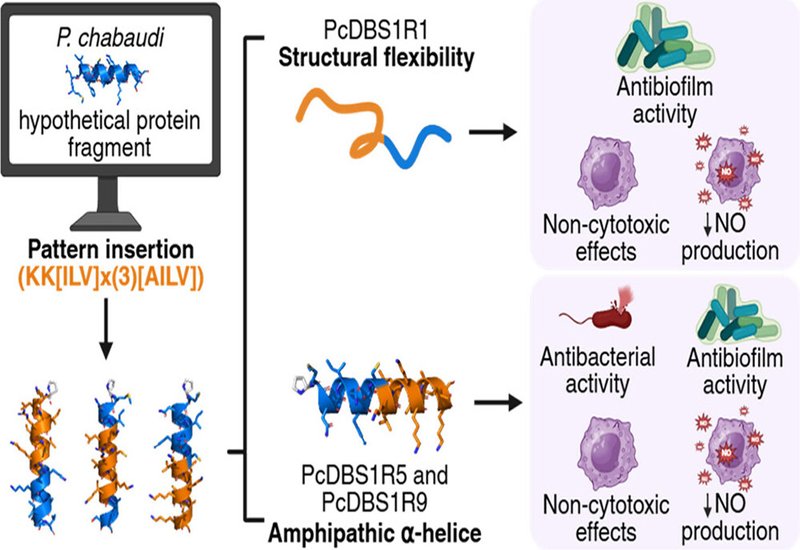
Researchers in the Cardoso Lab at Universidade Católica Dom Bosco, published in ACS Med. Chem. Lett., applied the Joker computational design algorithm to a hypothetical protein fragment from the malaria parasite Plasmodium chabaudi (GenBank: CAH75736.1). Joker works by sliding an α-helical antimicrobial pattern, KK[ILV]x(3)[AILV], across a non-AMP input sequence, generating a family of variants. From nine candidates produced in an earlier screen against Pseudomonas aeruginosa, the team selected three, PcDBS1R1, PcDBS1R5, and PcDBS1R9, based on low minimal inhibitory concentrations and minimal hemolytic activity. The three peptides were chemically synthesized, verified by MALDI-TOF MS, and characterized structurally by circular dichroism and NMR before biological evaluation against antibiotic-resistant clinical isolates and murine macrophages.
Structural characterization revealed a clear divide among the three peptides. In membrane-mimetic environments such as SDS micelles and 30% trifluoroethanol, PcDBS1R5 and PcDBS1R9 adopted well-defined α-helical conformations with helicities reaching 49–65%, consistent with their high hydrophobic moments and amphipathicity. PcDBS1R1, by contrast, displayed a mixed α-helix/β-structure signature in SDS and carried the shortest helical segment in NMR analysis, spanning only Thr8 to His12. Temperature coefficient data confirmed that PcDBS1R1 is the most conformationally flexible of the trio. Against an antibiotic-resistant A. baumannii clinical isolate that showed high-level resistance to all 11 antibiotics tested, PcDBS1R5 and PcDBS1R9 reduced planktonic cell growth by approximately 85% and 89% at 64 μmol L−1, respectively, while PcDBS1R1 achieved roughly 44% inhibition at the same concentration. None of the peptides showed activity against ATCC reference strains of A. baumannii or either K. pneumoniae strain tested.
Biofilm assays told a different story. PcDBS1R1, despite its weaker bacteriostatic profile, inhibited biofilm formation by the A. baumannii clinical isolate by approximately 95% at just 16 μmol L−1, a lower concentration than the 32 μmol L−1 required for PcDBS1R5 and PcDBS1R9 to achieve comparable inhibition of 92% and 94%, respectively. Against the K. pneumoniae clinical isolate, PcDBS1R1 again led with approximately 91% inhibition at 16 μmol L−1, outperforming the other two peptides at equivalent doses. The authors propose that PcDBS1R1's conformational plasticity may favor interactions with biofilm matrix components or quorum-sensing molecules rather than driving direct membrane disruption. In LPS-stimulated RAW 264.7 macrophages, all three peptides reduced nitric oxide production at 16 μmol L−1 by 59–78%, and none caused significant cytotoxicity up to 128 μmol L−1.
The complementary activity profiles of these three peptides illustrate how structural scaffold dynamics, not just amphipathicity or charge alone, shape AMP function. PcDBS1R1's flexibility and selective antibiofilm potency suggest a mechanistic route independent of membrane permeabilization, consistent with precedents from LL-37 and human β-defensin-2. The concurrent suppression of macrophage nitric oxide without cytotoxicity points toward dual antibiofilm and immunomodulatory utility. The authors call for follow-up studies to clarify mechanisms governing biofilm matrix targeting and host immune modulation, both in vitro and in vivo, and position the PcDBS1 series as scaffolds for rational design of next-generation peptide therapeutics against biofilm-associated, drug-resistant infections.